

Blog
The agents aren't the advantage
Every organisation in IBM and Microsoft's survey of 1,000 C-suite executives is raising its agentic AI budget. The ones seeing six times the productivity gains are the ones who built the capabilities around the agents.
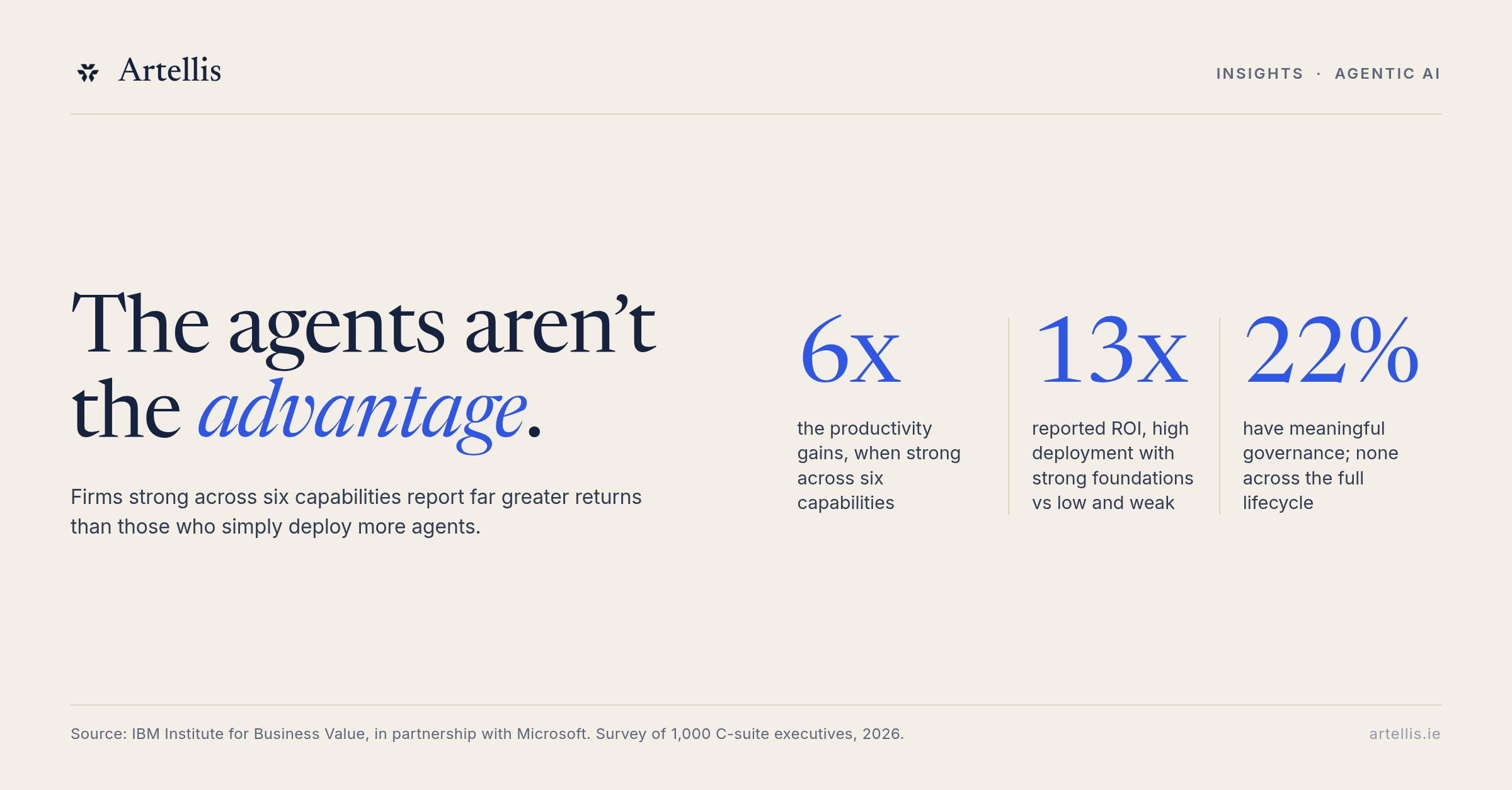
A new IBM Institute for Business Value report, produced with Microsoft, surveyed 1,000 C-suite executives. Every organisation in the study is increasing its agentic AI budget.
That part is not surprising. What is surprising is the spread in the results.
Firms that are strong across six capabilities — ecosystem strategy and design, governance, controls, work design and workforce readiness, execution, and a learning loop that ties them together — report six times the productivity gains of weaker peers, and more than twice the revenue attributed to their AI operations (IBM Institute for Business Value, with Microsoft, 2026).
The same research finds a 13 times difference in reported ROI between organisations with a high rate of agent deployment and strong foundations, and those with a low rate and weak foundations.
The agents themselves are not what creates that gap. Rivals can buy the same models and the same tools. They cannot buy the habits you build around them: measuring outcomes, keeping a governed register of what you have running, learning from what works, and redesigning the work rather than bolting an agent onto the old process.
The survey is of large organisations, so I would not hang those exact multiples on a fifty-person firm. The pattern still holds at a smaller scale. The teams that get value are the ones who measure the work, name an owner, and change the process, not the ones who simply switch on another agent.
Most organisations are still early on that front. Only 22% report meaningful governance design and operational controls, and none of the more than 900 organisations asked had those controls in place across the whole agentic lifecycle — identity, permissions, traceability and the ability to shut an agent down. 63% of executives say you need an ecosystem strategy to scale, but only 22% have one. And just 11% report a transformational redesign of roles, workflows and team structures.
That last figure is the one I sit with. In the workshops I run, people are often ready to build. The organisation around them is usually not. An agent that drafts a reply, a quote or a training note is useful. It becomes valuable when someone owns it, when it is tested, when it knows when to hand over to a person, and when you can see whether it is actually saving time.
That is the work we do at Artellis. In our Copilot Studio training, teams build a real agent in a sandbox, against one genuine scenario from their own work. We treat governance as part of the build, not a gate at the end: who owns it, what it can read, when a person has to approve the output, and how you will tell if it is doing its job. We also help teams put a simple register in place, so agents do not multiply quietly in the background.
IBM's advice is practical, and it matches what I see on the ground. Measure the outcome, not just the activity. Build a learning loop so the next agent is better than the last. Keep a governed register. And do not scale a workflow until the capabilities around it are ready.
If you want to talk through what that would look like in your team — one agent, clearly owned, with a human in the loop — twenty minutes is enough to get to a straight answer.
Common questions
- What does the IBM research actually find?
- In a 2026 survey of 1,000 C-suite executives, conducted by the IBM Institute for Business Value with Microsoft, every organisation was increasing its agentic AI budget. Firms strong across six capabilities report six times the productivity gains of weaker peers, more than twice the revenue attributed to their AI operations, and a 13 times difference in reported ROI between high deployment with strong foundations and low deployment with weak foundations.
- What are the six capabilities?
- The report's Agentic AI Value Model covers ecosystem strategy and design, governance, controls, work design and workforce readiness, execution, and a learning loop that connects them.
- Why does the 22% governance figure matter?
- Only 22% of organisations report meaningful governance design and operational controls, and none of the more than 900 asked had those controls across the whole agentic lifecycle — identity, permissions, traceability and shutdown. Without that, it is hard to learn from what is running, or to shut something down if it goes wrong.
- What should a team do first?
- Build one agent, in a sandbox, against a real piece of work. Give it an owner, a clear limit on what it can read, a human approval step, and a simple way to measure whether it is saving time. Do not scale it until those pieces are in place.
One Workflow
One workflow a week, worth automating.
I look at what your company actually does and write you a short letter: the opportunity, the likely hours it gives back, how involved it is, where the human review sits, and a first step you could run yourself this week. Founding cohort, limited to 100 companies while I personally review every week's recommendations. Reply to any letter and you reach me, not a form.
See a sample letter and how it works
Everything in the letter is decision support: review, test and approve before anything runs in your business. Your email is used for One Workflow only.